
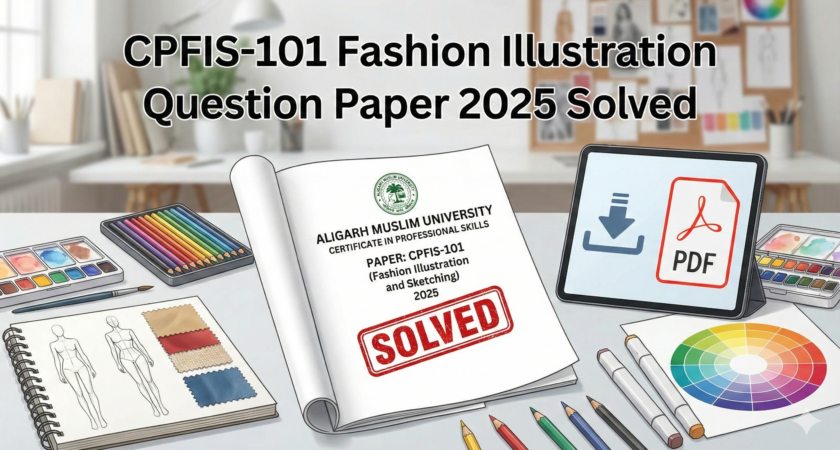
For students enrolled in the Certificate in Professional Skills course, the CPFIS-101 Fashion Illustration Question Paper 2025 tests your artistic ability and understanding of design theory. This paper bridges the gap between a creative idea and a physical garment, focusing on color theory, texture, and sketching techniques.
Below, you will find the complete solution for the Short Term Batch II 2025 examination. We have provided detailed explanations for color harmonies, design principles, and the tools used in professional illustration.
Download Question Paper
Solved Paper: Fashion Illustration and Sketching
Paper Code: 7406 Max Marks: 50 Duration: 2 Hours
Note: Answer only three questions, selecting one from each unit.
UNIT-I
Q1. What is the signification of illustration and sketching?
Significance of Illustration and Sketching: Fashion illustration is considered the “language” of fashion design. Its significance includes:
- Visualization: It allows the designer to get ideas out of their head and onto paper, making abstract concepts visible.
- Communication: It serves as a blueprint for pattern makers and tailors. A sketch details the silhouette, seam lines, and fabric drape, ensuring the final product matches the designer’s vision.
- Marketing & Sales: High-quality illustrations are used in lookbooks and mood boards to sell a collection to buyers before the actual garments are manufactured.
- Experimentation: Sketching allows designers to test different color combinations and fabric choices quickly without wasting expensive materials.
OR
Q1. Describe the different mediums used in illustration.
Fashion illustrators use various mediums to create different textures and effects:
- Pencils (Graphite/Color): Used for initial sketches and shading. Hard pencils (H) are for fine lines, while soft pencils (B) are for shading.
- Watercolors: Popular for their transparency and fluidity, perfect for depicting lightweight fabrics like chiffon or silk.
- Markers: Alcohol-based markers (like Copics) allow for smooth blending and bold, vibrant colors. They dry quickly and are industry standards.
- Charcoal/Pastels: Used for rough, expressive sketches with soft edges and rich textures.
- Digital Tools: Tablets and software (like Procreate or Adobe Illustrator) are increasingly used for clean, editable, and shareable designs.
UNIT-II
Q2. Explain in detail any three colour harmonies with the help of neat diagrams.
Color harmonies are aesthetically pleasing combinations of colors:

- Monochromatic Harmony: Uses a single color (hue) with variations in lightness and saturation (tints and shades). Example: Light blue, Navy blue, and Royal blue together. It creates a clean and cohesive look.
- Analogous Harmony: Uses colors that are next to each other on the color wheel. Example: Red, Orange, and Yellow. These colors blend well and are often found in nature.
- Complementary Harmony: Uses two colors that are directly opposite each other on the color wheel. Example: Blue and Orange. This creates high contrast and makes the design pop.
OR
Q2. Discuss the classification of colour with the help of colour wheel.
The color wheel classifies colors into three main categories:
- Primary Colors: The root colors that cannot be created by mixing others.
- Red, Yellow, Blue.
- Secondary Colors: Created by mixing two primary colors in equal parts.
- Red + Yellow = Orange
- Yellow + Blue = Green
- Blue + Red = Violet (Purple)
- Tertiary Colors: Created by mixing a primary color with a secondary color.
- Examples: Red-Orange, Blue-Green, Yellow-Orange.
UNIT-III
Q3. What effect does texture have on a dress? Explain in detail.
Texture refers to the surface quality of a fabric (how it feels and looks). It significantly affects the appearance of a dress:
- Visual Weight: Bulky textures (wool, fur) add volume and make the wearer look larger. Smooth textures (silk, satin) generally look sleeker but can cling to the body.
- Light Reflection:
- Shiny Textures (Satin/Sequins): Reflect light and make the figure appear larger or highlight curves.
- Matte Textures (Cotton/Denim): Absorb light and generally have a slimming effect.
- Mood: Rough textures (tweed) suggest casual or professional wear, while soft, sheer textures (chiffon) suggest romance and elegance.
OR
Q3. Write short notes on the following:
- a) Proportion: The relationship between the size of different parts of a design to the whole. In fashion sketching, the “9-head croquis” is a standard proportion used to elongate the legs and make the figure look elegant.
- b) Balance: The distribution of visual weight in a garment.
- Symmetrical Balance: Both sides of the garment are identical (formal look).
- Asymmetrical Balance: The two sides are different but still visually stable (modern/edgy look).
- c) Rhythm: The repetition of lines, colors, or shapes that guides the viewer’s eye across the garment. This can be achieved through repeating buttons, pleats, or prints.
- d) Emphasis: The focal point of the design—the first thing you notice. It could be a bold neckline, a bright belt, or intricate embroidery.